Planetary Hours
Know which planet rules this moment - plan your actions wisely. Embeddable domain-locked widget, mobile-responsive.
Add this widget to your site
Free forever. Copy the snippet and paste it into any page — no coding required.
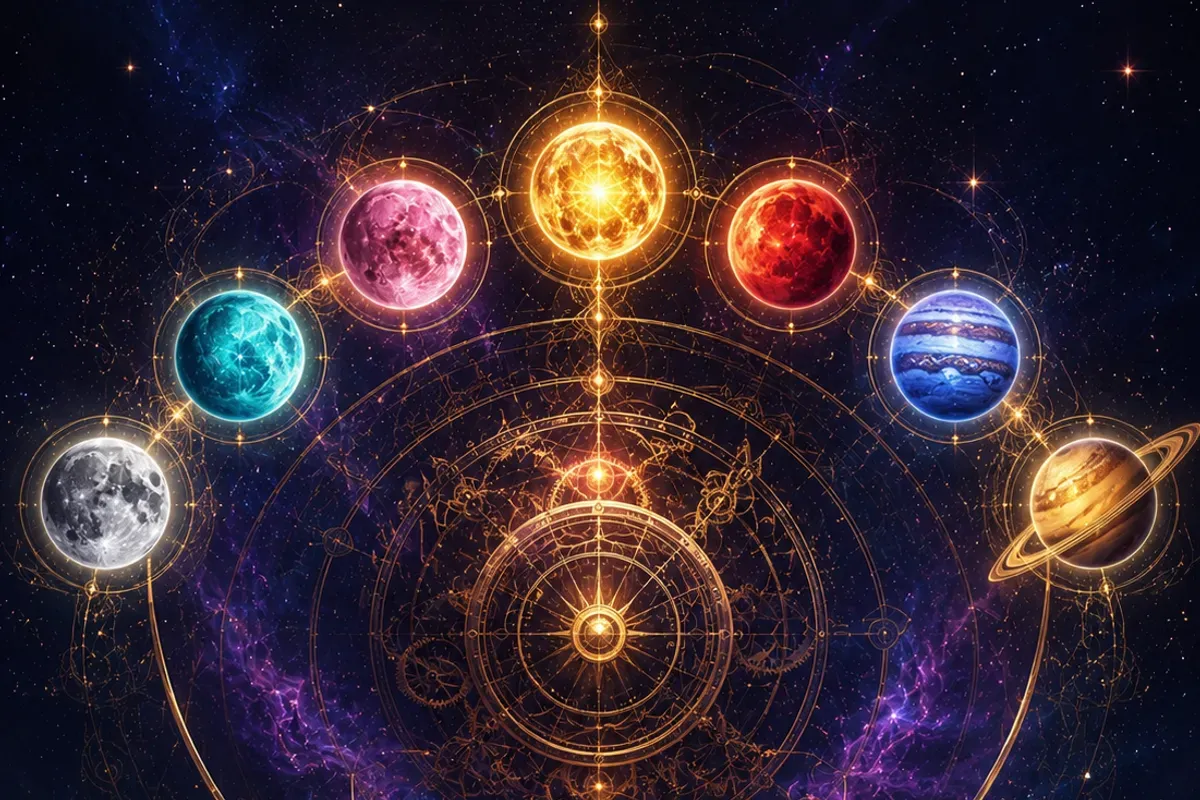
Planetary hours divide every day and night into twelve unequal segments, each ruled by one of the seven classical planets. The hour you're in right now has a planetary signature - Mercury sharpens communication; Saturn slows and tests; Venus draws connection; Mars pushes action. Practitioners of traditional astrology, Hermetic magic, and folk timing have used planetary hours for centuries to choose when to act, when to wait, and when a particular kind of effort is most supported by the prevailing influence.
How it works
Enter your location or allow geolocation - the calculator uses your local sunrise and sunset to compute the exact hour lengths for today. Daytime hours run from sunrise to sunset (twelve hours, each a different length depending on season); nighttime hours from sunset to sunrise. The first hour of each day is ruled by that day's namesake planet. The sequence cycles through all seven from there.
Understanding your result
The calculator shows you the current planetary hour, the ruling planet, and what that planet governs - along with a brief on the hours ahead and which hours today are best suited for specific kinds of work. Mercury hours favor writing, negotiation, and quick decisions. Jupiter hours suit expansion, generosity, and long-range planning. Mars hours are better for physical effort or cutting through something stuck. The chart gives you the day's full sequence so you can plan forward.
Frequently asked questions
Why are planetary hours unequal in length?
Because they're calculated from actual sunrise and sunset, not clock time. In summer at northern latitudes, daytime hours are longer than nighttime hours and vice versa. Seasonal variation is built in.
Which tradition does this calculation follow?
The Chaldean order of the planets (Saturn, Jupiter, Mars, Sun, Venus, Mercury, Moon), which is the system used in Hellenistic and Renaissance astrological magic and in most Western esoteric traditions that work with planetary timing.
Do I need to be an astrologer to use this?
No. The tool labels what each hour is good for. You don't need to know your natal chart - just your location and what you're trying to do.
Should I plan everything around planetary hours?
Traditional practitioners use them as one layer of timing among several. Useful input, not a governing rulebook. Treat them as weather rather than law.